Environmental Targets and Information Disclosure
ANA Group Environmental Targets
"2050 Environmental Goals" & "2030 Environmental Targets"
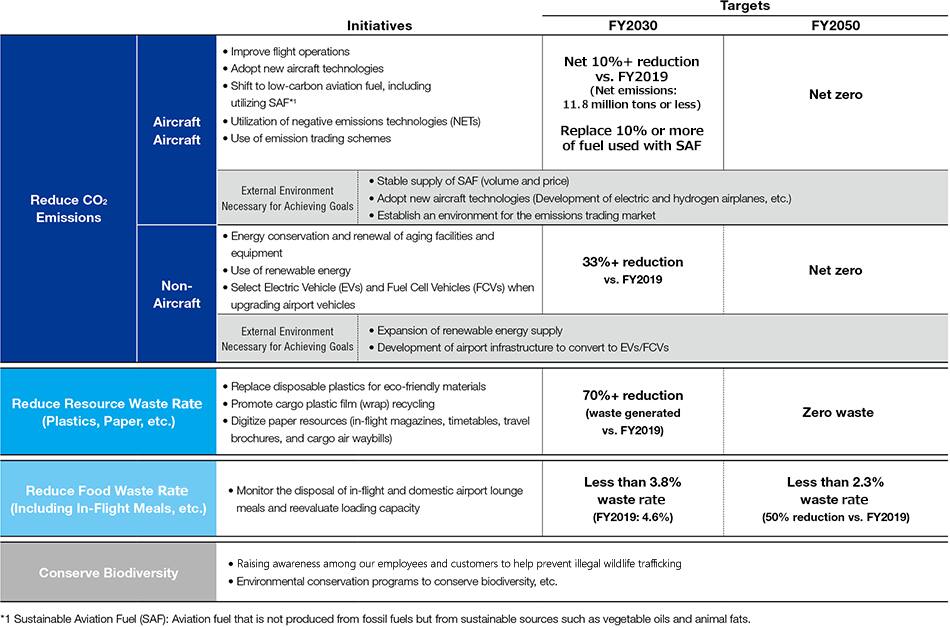
To achieve these goals, ANA Group is advancing the decarbonization of air transportation by combining operational improvements, technological innovation in aircraft, the use of Sustainable Aviation Fuel (SAF), emissions trading, and negative emission technologies, with SAF at the core.
In 2021, ANA Group launched the SAF Flight Initiative: For the Next Generation.
The Group is also introducing AeroSHARK technology on Boeing 777 aircraft and increasing the share of fuel-efficient aircraft as part of its fleet strategy.
In addition to direct emission reductions, ANA Group is addressing residual CO2 emissions that cannot be reduced through SAF and other measures alone through Negative Emissions Technologies (NETs), including DAC (Direct Air Capture).
In March 2022, ANA Group entered into a basic agreement with Climeworks regarding high-quality, permanent CO2 removal technologies. In August 2023, ANA Group also signed a procurement agreement with 1PointFive for carbon dioxide removal credits, the first such agreement by an airline. ANA Group plans to procure more than 30,000 tons of carbon dioxide removal (CDR) credits over the three years beginning 2025.
In its Medium-term Corporate Strategy FY2026-2028, ANA Group announced a record-high investment of 2.7 trillion yen over the next five years. Through continued operational improvements and the promotion of SAF adoption, ANA Group will continue striving toward its long-term 2050 net-zero CO2 emissions goal.
- We are working to decarbonize the air transport business by utilizing new technologies, while at the same time protecting the employment of Group employees by expanding profit opportunities through the use of data assets. To this end, in addition to the above initiatives, we have launched a specialized Organization specializing in environmental measures for aviation business, provided new education for training digital specialists, and strengthened communication with customers and labor unions through the ANA Future Promise. In addition, the ANA Group is encouraging the Japanese government to formulate policies for the stable procurement of SAF, which is essential for decarbonization, and our opinions are reflected in the Clean Energy Strategy (interim arrangement).
"2030 Environmental Targets" Progress and Results
Reduce CO2 Emissions (Aircraft operation)
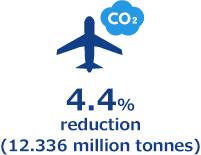
- Target
By FY2030 - ≧10% Net Reduction vs. FY2019 (Well below approx. 11.8 million tonnes levels)
- Actual FY2025
- 4.4% reduction / 12.336 million tonnes
- Includes CO2 emissions for Nippon Cargo Airlines (NCA) from August to March of FY2025.
Reduce CO2 Emissions (Non-Aircraft operation)
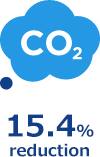
- Target
By FY2030 - 33%+Reduction
vs. FY2019 - Actual FY2025
- 15.4% reduction
Reduce Resource Waste Rate (Plastics, Paper, etc)
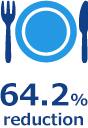
- Target
By FY2030 - 70%+reduction
vs. Disposal volume in FY 2019 - Actual FY2025
- 64.2% reduction
Reduce Food Waste Rate (Including In-Flight Meals, etc)

- Target
By FY2030 - Reduce to less than 3.8%
(FY2019: 4.6%) - Actual FY2025
- 3.9%
Other environmental targets
Measures for Air Pollution

- Target
- All aircraft, including leased aircraft, to conform to Chapter 4 of the International Civil Aviation Organization (ICAO) emission standards. 100%
- Actual
- All aircraft in conformance
- Target
- Actively introduce low-pollution vehicle
(Improvement over previous year) - Actual
- Percentage of low-emission vehicles*
63.6% (Previous year:62.2%)
- Fuel cell, electric, hybrid, or emission constraint vehicles
Noise Measures

- Target
- All aircraft, including leased aircraft, to conform to Chapter 4 of the ICAO noise standards.
- Actual
- All aircraft in conformance
Biodiversity

- Target
- Promoting biodiversity conservation
- Actual
- Support for coral reef conservation activities / Participation in invasive plant control activities / Hosting seminars aimed at eradicating illegal wildlife trade / Initiatives for forest conservation activities
Initiatives as an Eco-First Certified Company
In 2008, ANA became the first company in the transportation and aviation industry to receive "Eco-First Company" certification from Japan's Minister of the Environment. As a certified company, ANA continues to practice environmental management based on its "Eco-First Commitment" submitted to the Minister.
Furthermore, ANA HOLDINGS INC. endorsed "Deco Katsu"—a national movement promoted by the Ministry of the Environment to foster decarbonized lifestyles—issuing its "Deco Katsu Declaration" and joining the public-private partnership platform "Deco Katsu Supporters." Across the ANA Group, the company collaborates with stakeholders to raise environmental awareness and advance initiatives toward a decarbonized society.
Disclosure Based on TCFD Recommendations
The ANA Group expressed its support for the recommendations of the Task Force on Climate-related Financial Disclosures (TCFD) in March 2019, and since then has been disclosing information in accordance with the TCFD recommendations. We will continue to enhance our disclosure content in line with the TCFD recommendations.

Governance
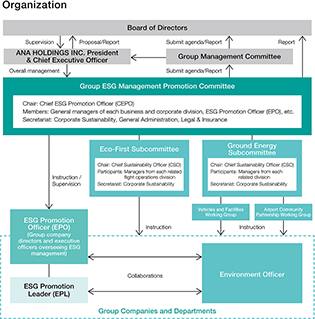
The ANA Group established the Group ESG Management Promotion Committee in accordance with Group ESG Management Promotion Committee Regulations. This committee, which operates under the guidance of the president and under the chairmanship of the director in charge of corporate sustainability (CEPO: Chief ESG Promotion Officer), consists of ANA HOLDINGS INC. and group company directors, executive officers, and the full-time Audit & Supervisory Board members of ANA HOLDINGS INC. The committee discusses core policies and measures related to ESG management, including risk management and compliance and progress against targets is monitored four times a year.
In addition, important issues directly related to management are discussed at the Group Management Committee and reported to the Board of Directors and the Board of Corporate Auditors.
The Board of Directors is tasked with formulating group-wide management policies and targets, including those related to climate change issues, and is responsible for overseeing the management and business execution of Group companies.
Through regular dialogues with external ESG experts, the ANA Group obtains an understanding of the latest social demands and changes in people's interest in a timely manner, and evaluates their impact on the Group's business and society. The Group incorporates the insight from the evaluation into management strategies and implements the strategies accordingly.
Based on these regulations, each Group company has appointed an ESG Promotion Officer (EPO) as the person responsible for promoting ESG management and participates as a member of the Group ESG Management Promotion Committee, and each Group company and department has an ESG Promotion Leader (EPL) to lead the ESG activities of their respective organization.
Matters discussed, resolved, and reported at the Board of Directors, Group Management Committee, and Group ESG Management Promotion Committee are shared and implemented throughout the entire Group in close collaboration with EPOs and EPLs. We also hold EPL meetings twice a year to share information in a comprehensive manner and promote initiatives at each Group company and department.
In addition, in order to realise the company's sustainable growth and increase its corporate value over the medium and long term, ESG management incorporates an objective and multifaceted approach, with 'CO2 emissions volume' and 'ESG external evaluation indicators', etc are used as evaluation indicators, which are also reflected in the officer remuneration.
Details as below
Examples of climate change related agendas submitted and reported to the Board of Directors thus far
- Formulation of related Policies (Environmental, Biodversity etc.), medium- to long-term environmental targets, and annual results
- Information disclosure in line with the TCFD Recommendations
- Development of a transition strategy to achieve net zero by 2050
- Incorporating a climate change perspective into the medium-term management strategy
- Progress in the Group's efforts to address climate change issues
Strategy
To identify climate-related risks and opportunities, assess financial impacts, and consider countermeasures for the core aviation business, the ANA Group conducted a climate scenario analysis based on the TCFD recommendations.
This analysis references public climate scenarios, primarily the IPCC Sixth Assessment Report (AR6) and the IEA Net Zero Emissions by 2050 Scenario (NZE), evaluating the 1.5°C and 4°C warming pathways *1. For the assessment of transition risks, the analysis incorporates the Japanese government's 2030 Nationally Determined Contribution (NDC) and related energy policies. The time horizon spans from FY2030 to FY2050, in alignment with the ANA Group’s Medium-to-Long-Term Environmental Targets.
- *1.
- 4°C scenario
a scenario in which no action is taken against climate change that exceeds current situation, resulting in a temperature increase by approximately 4°C compared to the level from the Industrial Revolution, and a risk of "physical" changes caused by climate change becoming apparent. - 1.5°C scenario
a scenario in which a radical system transition is achieved, resulting in a temperature increase by less than 1.5°C compared to the level from the Industrial Revolution, and a risk of the "transition" to a low-carbon economy becoming apparent.
- 4°C scenario
Business Impact Estimation Method and Medium-Long Term Financial Impacts
Based on the scenario analysis, we have identified risks and opportunities with a large financial impact (an annual impact of 10 billion yen or more) and estimated the single-year financial impact on fiscal 2030 and on fiscal 2050. These estimations include potential risks, uncertainties, and assumptions, and the actual scale of impact may therefore widely vary depending on the variability of these factors. Recognizing this, we will incorporate changes in the situation into our evaluations in a timely manner.
|
Type
|
Financial impact
|
Description
|
Estimation method
|
||
|---|---|---|---|---|---|
|
Medium term
|
Long term
|
||||
| Acute risk Physical | Increasing severity/frequency of extreme weather events |
Large
|
Large
|
|
Lost revenues from flight cancellations due to weather conditions associated with increases in the frequency of extreme precipitation over land are estimated, taking into account the comparable losses recorded in fiscal 2019 and the increased frequency of such weather events. *3*4 |
| Risk Transition | Actions to reduce CO2 emissions (Aircraft) SAF New technology Carbon credits |
Large
|
Small to large
|
【SAF*5】
|
Cost increases are estimated from the price gap between SAF and jet fuel (kerosene), which is determined from future price forecasts, and the amount of fuel to be procured to fulfill the quantity required for operations assumed in the transition strategy. Although SAF prices in fiscal 2050 will be lower due to mass production, the estimated cost increases are obtained by multiplying any remaining price gap between SAF and jet fuel by the amount of procured fuel. *6 |
|
To be estimated
|
New technology
|
The transition strategy does not include the introduction of next-generation aircraft. We forecast that the real-world deployment of electric aircraft and hydrogen-powered aircraft will occur in 2030 or beyond. We will later estimate the financial impact of introducing such aircraft, taking into account the expected equipment prices. | |||
|
Small to large
|
Medium to large
|
Carbon credits*7
|
Cost increases are estimated based on the forecast credit prices for financial 2030 and 2050, which are obtained by applying the annual price increase rate used by ICAO for price forecasts (2021-2026) of CORSIA Eligible Emissions Units, and on the forecasted quantity of emissions units to be required and negative emissions technologies as set out in the transition strategy. *8 |
||
| Opportunity Transition | Actions to reduce CO2 emissions (Aircraft) New technology |
Large
|
Large
|
New technology
|
With respect to the CO2 emissions expected in the business scale defined in the transition strategy, we plan reduce out total emissions by 15% by fiscal 2030 and 20% by fiscal 2050 through operational improvements and technological innovations in aircraft. These emissions reductions are converted into reductions in fuel consumption to estimate the reduction in fuel procurement cost. SAF prices assumed for fiscal 2050 range from those equivalent to kerosene prices to the price forecast for fiscal 2030. *5*6*10*11 |
- *2. Financial impact:A financial impact expected from the materialization of each identified risk is evaluated on a three-point scale of "large," "medium," and "small." A single-year financial impact is estimated for each of the items classified as large, and the estimation is provided separately for the medium term (through fiscal 2030) and the long term (through fiscal 2050).
Large: ≥10 billion yen per year, Medium: ≥1 billion yen and <10 billion yen per year, Small: <1 billion yen per year - *3. Neither the increases in operational costs nor the increases in the cost of repairing aircraft and facilities damaged by disasters are included (subject to future consideration).
- *4. References: IPCC Sixth Assessment ReportClimate Futures, Infographic TS.1, Infographic TS.1 in IPCC, 2021: Technical Summary. In: Climate Change 2021: The Physical Science Basis. Contribution of Working Group I to the Sixth Assessment Report of the Intergovernmental Panel on Climate Change [Chen, D., M. Rojas, B.H. Samset, K. Cobb, A. Diongue Niang, P. Edwards, S. Emori, S.H. Faria, E. Hawkins, P. Hope, P. Huybrechts, M. Meinshausen, S.K. Mustafa, G.-K. Plattner, and A.-M. Tréguier, 2021: Framing, Context, and Methods. InClimate Change 2021: The Physical Science Basis. Contribution of Working Group I to the Sixth Assessment Report of the Intergovernmental Panel on Climate Change[Masson-Delmotte, V., P. Zhai, A. Pirani, S.L. Connors, C. Péan, S. Berger, N. Caud, Y. Chen, L. Goldfarb, M.I. Gomis, M. Huang, K. Leitzell, E. Lonnoy, J.B.R. Matthews, T.K. Maycock, T. Waterfield, O. Yelekçi, R. Yu, and B. Zhou (eds.)]. Cambridge University Press, Cambridge, United Kingdom and New York, NY, USA, pp. 147-286, doi:10.1017/9781009157896.003.]
- *5. SAF: Sustainable aviation fuel, a jet fuel produced from sustainable sources that emits less CO2 in the process from raw material production and sourcing to combustion.
- *6. For SAF price forecasts, we used Sustainable Aviation Fuels Mandate-Consultation-stage Cost Benefit Analysis, a document issued by the UK government in 2023.
- *7. Carbon credits: Providing a mechanism to quantify CO2 emissions reductions, carbon credits are tradable as emissions rights.
- *8. For the estimation of financial impacts, prices of carbon credits produced by using negative emissions technologies are assumed to be equivalent to the prices of CORSIA Eligible Emissions Units.
- *9. DAC (Direct Air Capture):A technology that extracts CO2 directly from the atmosphere.
- *10. Fuel cost reduction estimates are based on FY2026 business plan assumptions (exchange rate: 155 JPY/USD; jet fuel price: 125 USD/bbl).
- *11. For the estimation of CO2 emissions, the transition strategy uses 3.16 kg-CO2/kg as the emissions factor for jet fuel, which is the same emissions factor as used in the Carbon Offsetting and Reduction Scheme for International Aviation (CORSIA) of the International Civil Aviation Organization (ICAO).
Disclosures Based on TCFD Recommendations
Strategy
Overview of Scenario Analysis (4°C / 1.5°C)
Methodology and Financial Impact Assessment
Transition Plan Toward Net-Zero Emissions
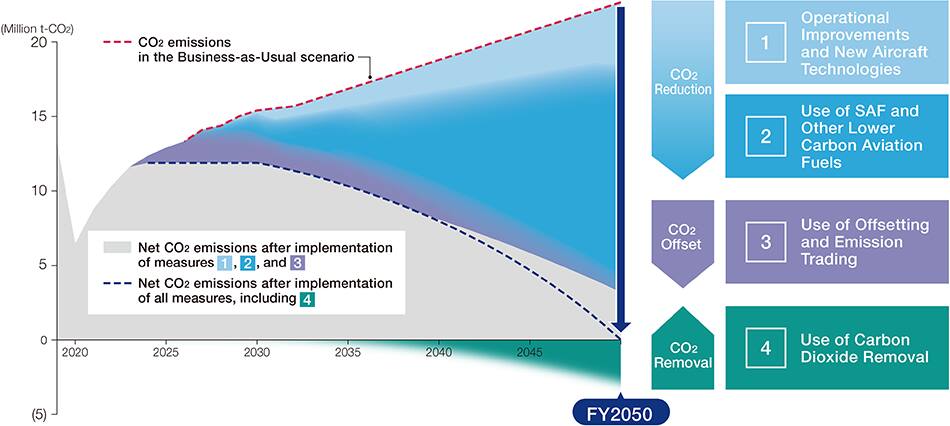
ANA Group has established a comprehensive transition strategy in flight operations to reach its long-term 2050 environmental goal and is steadily driving its implementation. Specifically, we strategically procure and leverage Sustainable Aviation Fuel (SAF) and carbon credits, carefully balancing market availability and economic viability. By remaining flexible amid external uncertainties and pursuing an optimal mix of solutions, we are committed to achieving our medium- and long-term environmental targets for FY2030 and FY2050.
Following the integration of Nippon Cargo Airlines (NCA) into ANA Group in August 2025, we updated our "Plans to promote decarbonization in the air transportation business." The revised plan incorporates quantitative targets for FY2030 and FY2050 across key pillars, including operational improvements, new aircraft technologies, use of SAF and other lower carbon aviation fuels, and the use of emissions trading schemes. In June 2026, the Ministry of Land, Infrastructure, Transport and Tourism (MLIT) officially approved these updated plans.
To ensure a steady transition toward our long-term environmental goals, ANA remains steadfast in its medium-term environmental target: reducing net CO2 emissions across domestic and international flights by at least 10% compared to FY2019 levels by FY2030. Moving forward, we will continue to advance a strategy that successfully balances profitability with decarbonization.
- Operational Improvements and New Aircraft Technologies
- Promoting fuel efficiency measures tailored to each flight phase
- Innovating air traffic systems in collaboration with MLIT
- Introducing next-generation fuel-efficient aircraft
- Decarbonizing Aviation Fuel Through SAF Utilization
- Securing a stable supply of required SAF volumes
- Advancing public-private and cross-industry partnerships to expand domestic production, lower costs, and build supply chains
- Expanding the "SAF Flight Initiative"
- Utilization of Emissions Trading Schemes
- Securing eligible credits for CORSIA compliance obligations
- Complying with regional ETS*1 mandates (such as EU ETS)
- Leveraging Negative Emission Technologies (NETs)
- Leveraging Negative Emission Technologies (NETs)
- *1.ETS (Emissions Trading Scheme): A market-based mechanism where entities exceeding their allocated emission allowances purchase allowances from the market to balance their emissions.
Alignment Commitment to the Paris Agreement (1.5°C Pathway)
The ANA Group's Net-Zero Transition Plan is strictly aligned with the Paris Agreement's 1.5°C goal to limit global warming. Our near-term emission reduction targets (through FY2030) have been validated by the Science Based Targets initiative (SBTi) as science-based targets and our long-term decarbonization pathway to FY2050 is designed to be consistent with SBTi's Corporate Net-Zero Standard. Additionally, our operational transition pathways are fully integrated with the global net-zero aviation scenarios defined by the International Civil Aviation Organization (ICAO).
Financial Planning (CAPEX and Environmental Costs)
ANA Group considers initiatives toward achieving a decarbonized society to be a top management priority. To enhance predictability in our financial planning, we incorporate future costs associated with environmental impacts into our "ANA Group Value Creation Roadmap 2030." By factoring climate-related financial implications into our comprehensive financial planning, we strategically align our capital allocation with our decarbonization commitments.
Capital Expenditures (CAPEX)
For the six-year period from FY2025 to FY2030, ANA Group plans total capital expenditures of 3.0 trillion yen. Of this total, approximately 50% (around 1.5 trillion yen) will be allocated to international passenger and cargo operations, and approximately 15% (around 450 billion yen) to domestic passenger operations. This capital allocation financially underpins our transition to fuel-efficient aircraft. Having reached 82.7% in FY2024, our fuel-efficient fleet ratio is projected to rise to 90% by FY2030 (excluding the fleet of Nippon Cargo Airlines [NCA]). Key aircraft deliveries in FY2025 included two Boeing 787-10s and five Airbus A320neos. As of the end of FY2025, we have a total of 143 aircraft on order—including 30 Boeing 787-9s, 38 Boeing 737-8s, 27 Airbus A321neos, and 18 Boeing 777-9s—and will continue to actively drive the ongoing transition toward a fuel-efficient fleet.
Environmental Costs
In FY2030, ANA Group projects environmental costs of approximately 30 billion yen. These costs include compliance with the Carbon Offsetting and Reduction Scheme for International Aviation (CORSIA) and national Emissions Trading Schemes (ETS), as well as Sustainable Aviation Fuel (SAF) procurement driven by regulatory mandates and voluntary adoption. By managing these future costs appropriately, we aim to balance the achievement of our financial targets with our environmental commitments.
While advancing these environmental initiatives, we are equally focused on measures to curb total future costs. Specifically, through operational improvements and fleet renewal with fuel-efficient aircraft, we target fuel cost savings of approximately 25 billion yen in FY2030.
FY2030 Environmental Costs
Approx. 30 billion yen
FY2030 Fuel Cost Savings Target
Approx. 25 billion yen
Decarbonisation Levers by Scope
ANA Group is driving decarbonization across Scope 1, Scope 2, and Scope 3 emissions.
[Scope 1] Operational Improvements and New Aircraft Technologies
Direct CO2 Reduction
Reducing our direct CO2 emissions (Scope 1) is a top strategic priority for ANA Group. Specifically, we are investing in ongoing fleet renewal to reach a 90% fuel-efficient fleet ratio by the end of FY2030. In addition, we will maximize operational efficiency through initiatives such as introducing "AeroSHARK"—a riblet surface film that reduces aerodynamic drag—and leveraging AI-powered systems for optimal flight route selection.
[Scope 1 & Scope 3] Stable SAF Supply and Emissions Reduction Across the Value Chain
Value Chain Reduction
In parallel with reducing our Scope 1 operational emissions, we address the needs of corporate clients to lower their Scope 3 supply chain emissions. Specifically, we lead efforts to promote domestically produced SAF through cross-industry collaborations such as "ACT FOR SKY," while expanding our "SAF Flight Initiative (SFI)" for both corporate and individual customers. Additionally, we contribute to Scope 3 reductions across the entire value chain through a resource circulation model—selling used cooking oil generated during in-flight meal preparation as feedstock for renewable diesel (RD).
[Scope 1 & Scope 2] Decarbonization of Ground Operations (Facilities & Equipment)
Direct & Indirect Reduction
To reduce direct and indirect emissions (Scope 1 and Scope 2) from non-flight business activities, we are advancing decarbonization in our ground operations as follows:
Transition to EVs and Lifespan Extension for Ground Vehicles (Scope 1) By retrofitting diesel-powered ground vehicles slated for disposal into electric vehicles (EVs), we reduce CO2 emissions by approximately 2.1 tons per vehicle annually while extending their operational lifespan by around 15 years. We are expanding this dual-benefit model—combining waste reduction with decarbonization—across airport bases nationwide.
Facility Energy Optimization and Eco-Friendly Habits (Scope 2) We are installing solar power equipment at company facilities, such as our comprehensive training center "ANA Blue Base," while optimizing operational efficiency through Building Energy Management Systems (BEAMS) and energy-efficient flight simulators. In addition, we naturally promote energy-saving behavior across our facilities through fun, engaging initiatives that encourage voluntary employee participation. Alongside basic practices like turning off lights in training rooms, we launched the "Climb Stairs for SDGs" campaign. Tied to seasonal events like Halloween and Christmas, we place small treats—such as candies—on stair landings to reward stair use. Combined with our "2 UP 3 DOWN" initiative (taking the stairs when going up two floors or down three), these playful incentives empower employees to adopt eco-friendly habits in a lighthearted, natural way.
[Residual Emissions of Scope 1 & Scope 3] Leveraging Negative Emission Technologies (NETs)
Permanent Removal
To reliably achieve net-zero emissions by 2050, we are establishing a long-term framework to remove residual CO2 emissions that remain after executing all primary reduction measures, such as the use of SAF. Specifically, we are driving investments aimed at the future utilization of durable Carbon Dioxide Removal (CDR) credits. Key initiatives include securing offtake agreements with Direct Air Capture (DAC) companies that remove and store CO2, as well as investing in Terraton Industrial, Inc., a company with biochar-based carbon removal technology.
Social Impact Assessment and Just Transition
The ANA Group evaluates social impacts (risks and opportunities) that the net-zero transition process may have on workers and regional communities, actively driving a Just Transition.
Supporting Our Workforce: Autonomous Growth and Just Transition
The transition to decarbonization requires significant transformation in operational safety management and daily workflows. We actively identify potential impacts, such as psychological strain on frontline personnel, and drive a "Just Transition" grounded in continuous dialogue.
- Flight Operations:We use tailored training and dashboards to build eco-friendly crew habits—such as safely minimizing reverse thrust upon landing—embedding emissions reduction into daily operations.
- Ground Support Equipment (GSE) Electrification:Given supply and infrastructure uncertainties, we treat GSE electrification as a validation phase, supporting frontline teams with flexible training every step of the way.
Addressing Impacts on Communities (Sustainable Tourism and Regional Revitalization)
The ANA Group carefully evaluates the socio-economic impacts that rising transition-related environmental costs may have on regional flight route viability and local economies. Our business model is deeply dependent on regional natural capital and cultural resources. Therefore, we assess the depopulation of regional communities and the resulting labor shortages in local tourism as material physical and transitional risks that could lead to economic stagnation and a subsequent decline in aviation demand.
As a key mitigation action to support a Just Transition for regional communities, we actively promote Sustainable Tourism. This strategy stimulates and redistributes travel demand to regional airports that possess rich, valuable ecosystems but experience lower passenger volumes, helping to diversify travel demand toward under-visited regional destinations while driving regional economic development.
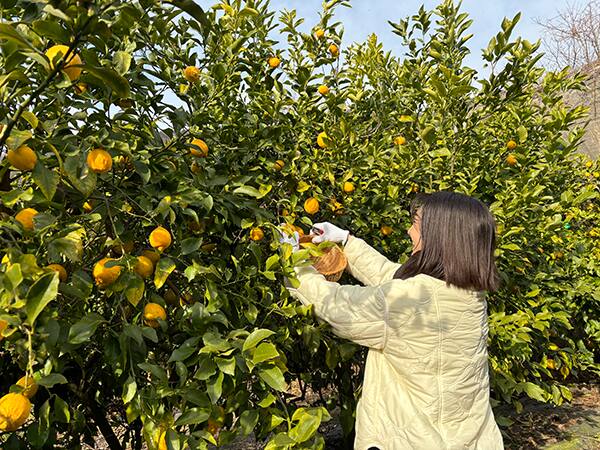
- The "ANA Farm Project" in Ehime Prefecture:In partnership with local farmers and municipal stakeholders, we rehabilitate abandoned agricultural lands to promote green tourism, ecological conservation, and hands-on agricultural experiences. This sustainable business model simultaneously restores natural ecosystems and revitalizes the local economy (regional creation), supporting regional communities in their transition toward a resilient, sustainable future.
Responsible Procurement (Sourcing Sustainability in SAF and Supply Chains)
When procuring key transition assets, such as Sustainable Aviation Fuel (SAF), the ANA Group mandates compliance with the "ANA Group Supplier Code of Conduct". This procurement framework incorporates comprehensive Environmental, Social, and Governance (ESG) perspectives, taking into account sector-specific and country-specific human rights and environmental risks. Guided by our strict policy to eliminate negative social and environmental externalities—including climate regression, biodiversity loss, and unfair labor exploitation (such as forced labor)—we systematically distribute our Code of Conduct to, and collect confirmations from, our upstream partners, ensuring robust and transparent responsible procurement across our value chain.
Sustainable Products and Services Program
The ANA Group formally classifies and promotes the "SAF Flight Initiative" (SFI) as a certified sustainable product and service. SFI is strictly aligned with the EU Renewable Energy Directive (EU RED) standards and is backed by annual independent third-party verification (limited assurance) conducted in accordance with ISO 14064-3. This partnership program directly enables our customers to mitigate their Scope 3 value chain emissions (specifically Category 4 and Category 6) through a collaborative cost-sharing model that distributes the financial transitional costs of decarbonisation across society.
Definitions and Certification Standards for Sustainable Products
Compliance with the EU Renewable Energy Directive (EU RED)
The lifecycle environmental attributes and Scope 3 reduction values generated and allocated through this program strictly comply with the sustainability and greenhouse gas emissions saving criteria defined under the EU Renewable Energy Directive (EU RED).
Independent External Verification under ISO 14064-3
To ensure the credibility, transparency, and traceability of our sustainable services, both the quantitative CO2 reduction effects derived from lifecycle SAF utilization and the validity of the "CO2 Reduction Certificates" issued to SFI participants undergo rigorous annual third-party external verification. This limited assurance engagement is performed by an independent, accredited greenhouse gas assertion body in accordance with the international standard ISO 14064-3.
SFI Portfolio Overview and Market Expansion
SFI serves as a leading sustainable product designed to facilitate value-chain carbon mitigation. As of July 2026, the SFI program has been successfully adopted by 22 corporate clients and organizations across Japan and international markets through our "SFI Corporate" and "SFI Cargo" programs.
【SFI Value Creation & Allocation Architecture】
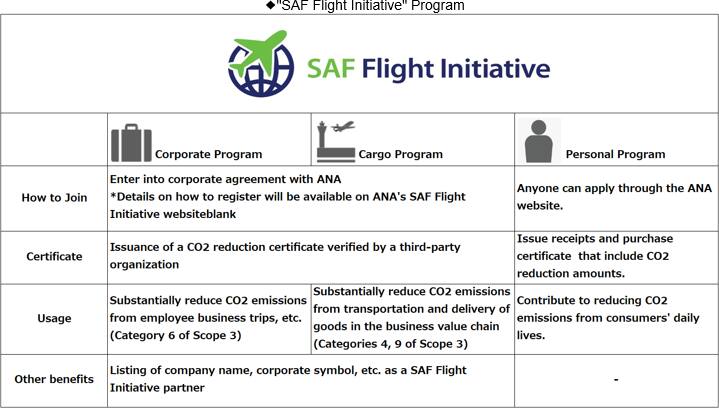
SFI Corporate and SFI Cargo (B2B Solutions)
To scale B2B market penetration, we offer flexible bilateral and tripartite contractual frameworks tailored to the complex supply chain requirements of both freight forwarders and shippers. Furthermore, we collaborate with metropolitan and regional government initiatives (such as Tokyo’s Scope 3 Logistics Carbon Mitigation Project) to structurally stimulate demand for sustainable aviation and pioneer robust green markets.
SFI Personal ・Program (B2C Launch - New for 2026)
To capture the growing consumer demand for voluntary climate action, we officially launched the "SFI Personal ・Program" in June 2026. By expanding our target audience from corporate travel to general individual passengers, we evolve SFI into a comprehensive, society-wide decarbonisation funding infrastructure.
Research and Development (R&D) Resources for Sustainable Portfolios
To continuously diversify and enhance our sustainable products and services portfolio, the ANA Group assigns structured Research and Development (R&D) resources toward technological frontier assets:
Carbon Removal through Corporate Venture Capital (CVC)
To address and neutralize long-term residual emissions, we utilize our strategic CVC fund to invest in cutting-edge Negative Emission Technologies (NETs). This includes our FY2025 strategic investment in US-based Terraton Industrial, a company specializing in biochar-based permanent carbon removal. This CVC-driven approach secures our group’s early access to next-generation Carbon Dioxide Removal (CDR) pathways, laying the foundation for our future high-integrity carbon credit procurement.
In-Sector Technology Innovation - "BlueWX" Meteorological AI
We allocate dedicated digital R&D resources to implement our proprietary "BlueWX" AI aviation platform. By combining real-time flight telemetry with high-precision turbulence predictive models, this system optimizes flight paths, significantly reduces inefficient detours, and directly reduces active Scope 1 CO2 emissions on active passenger routes.
Sales Infrastructure, Quantified Targets, and Market Enablement
To directly link our environmental transition services to corporate financial growth, the ANA Group integrates rigorous internal KPI management with active participation in global green market infrastructure development.
SFI Sales Performance KPI Management
As a core business and financial objective, the Group actively drives the expansion of SFI to manage carbon costs. We have established time-bound sales targets for the SFI program, formally integrating them into company-wide sales divisions' performance appraisals and KPI scorecards to ensure unified corporate mobilization toward program expansion.
Cross-Industry Engagement and Green Market Infrastructure
Beyond our individual sales efforts, the ANA Group leads industry-wide awareness and ecosystem development as a steering member of "ACT FOR SKY", a cross-industry alliance driving the commercialization of a domestic SAF supply chain. In partnership with key stakeholders including Narita International Airport Corporation (NAA) and the national Green Transformation (GX) Promotion Agency, we actively participate in formulating regulatory frameworks for Scope 3 environmental attribute trading, working to build a rules-based, transparent market infrastructure with the aim of stimulating long-term market demand for sustainable aviation.
Risk Management
Risk Management System
The ANA Group conducts risk management in accordance with the "ANA Group Total Risk Management Regulations," which were established based on the basic policy approved by the Board of Directors.
Major Risks for the ANA Group
- Safety is compromised and impeded.
- Effects of infectious diseases
- Addressing climate change issues
- Destabilization of global situations
- Occurrence of system failures
- Information leaks
- Human rights risks
- Intensifying natural disasters
- Market fluctuations, including exchange rate, oil price and interest rate fluctuations
- Investment intended to increase competitiveness and achieve new growth
- Shrinking of existing markets and difficulty in securing workforce due to population decrease
- Intensifying competition with land transportation
Internal Carbon Pricing (ICP)
ANA HOLDINGS INC. was selected to take part in the Ministry of the Environment's FY2022 Model Project of Using the Internal Carbon Pricing (ICP) Mechanism in Investment Decisions. In the future, ANA will establish and operate multiple categorized ICP schemes for a broad range of initiatives to ensure highly useful and effective investment (application to investment decision-making), with a view to complying with regulations and achieving targets.
Other disclosure on Climate Change
Evaluation by Carbon Disclosure Project (CDP)
The ANA Group calculates its greenhouse gas (GHG) emissions in accordance with the Act on the Rational Use of Energy and categorizes them into Scopes 1, 2, and 3 under the GHG Protocol. To ensure high transparency, these disclosures are verified through independent third-party assurance.
In addition to transparent reporting, the Group's climate governance, management strategies, and concrete reduction initiatives received comprehensive evaluation. As a result, the ANA Group was named to the prestigious Climate Change "A List"—the highest rating—in the CDP 2025 Climate Change Questionnaire announced in December 2025. This marks the fourth consecutive year of "A List" recognition for the Group, spanning from 2022 to 2025.
CDP is an international non-profit organization that, at the request of institutional investors, comprehensively evaluates corporate climate strategy, targets, and reduction measures alongside GHG emissions disclosures.
Science-Based Targets(SBT)
In November 2022, the ANA Group's greenhouse gas (GHG) emissions reduction targets were officially validated by the Science Based Targets initiative (SBTi) as science-based targets. The ANA Group was the first airline group in Asia to receive SBT validation.
Guided by these SBTi-validated targets as a roadmap, the ANA Group will continue to drive sustainable value creation through ESG management toward achieving net-zero GHG emissions by 2050.
as of 31/07/2026
|
Sources |
Science-Based targets by FY2030 |
UNIT |
FY2019 (Base Year) *1 |
FY2023 |
FY2024 |
FY2025 *2 |
|---|---|---|---|---|---|---|
| Aircraft operations (Scopes 1 and 3: Well to Wake *3) | Reduce CO2 emissions intensity per RTK *4 by 29% by FY2030 compared to the FY2019 base year (Target: 0.658 kg-CO2/RTK) |
kg-CO2/RTK |
0.926 |
1.009 |
0.985 |
1.003 |
| Non-aircraft operations (Scopes 1 and 2: vehicle fuel and facility electricity) | Reduce absolute CO2 emissions by 27.5% by FY2030 compared to the FY2019 base year (Target: 92,780 t-CO2) |
t-CO2 |
127,973 |
96,997 |
101,240 |
105,611 |
- *1:Following the integration of Nippon Cargo Airlines Co., Ltd. (NCA) into the Group in August 2025, FY2019 (base year) actual figures for CO2 emissions and Revenue Ton-Kilometers (RTK) have been retroactively recalculated by incorporating NCA's equivalent data, in accordance with SBTi criteria (NT C27) and GHG Protocol recalculation rules.
- *2:Includes NCA's CO2 emissions for FY2025 (August-March).
- *3:Refers to the full lifecycle from aviation fuel production and transport through to in-flight use (combustion).
- *4:A measure of air transport volume calculated under ICAO international standards as revenue weight in metric tons (passengers converted at 100 kg/person including baggage) multiplied by distance flown in kilometers.